
DD Direct Drive Motors in Washing Machines: Why Manufacturers Are Switching
For decades, the washing machine motor drove the drum through a belt and pulley. Today, a growing share of mid-range and premium machines skip the belt entirely: the motor sits directly behind the drum and turns it without any transmission. This is the DD direct drive motor — and its rapid adoption is reshaping how appliance motors are designed, built, and assembled. This article looks at why the switch is happening, what makes DD motors different to manufacture, and what it means for motor production lines.
What is a DD direct drive motor?
DD stands for direct drive. In a belt-driven washing machine, a small high-speed motor spins at several thousand rpm, and a belt reduces that speed to the drum. In a direct drive design, a large-diameter, low-speed motor — typically an outer-rotor BLDC motor — couples to the drum shaft directly. No belt, no pulley, no gearbox.
Why manufacturers are switching to direct drive
The shift is driven by four practical advantages:
1. Noise and vibration. Removing the belt eliminates a major noise source, and the large rotor diameter smooths torque delivery. Quiet operation is now a headline selling point in premium appliances. 2. Reliability. Belts wear, stretch, and snap. A direct drive system removes the most failure-prone wear part in the machine, cutting warranty claims. 3. Energy efficiency. BLDC direct drive motors adjust speed precisely to the load, improving wash performance per kilowatt-hour and helping machines meet tightening efficiency regulations. 4. Control. Direct torque control enables new wash motions — gentle tumbling, rapid reversing, precise drum positioning — that belt drives cannot deliver.
The result: what started as a premium feature is moving steadily into mainstream models, and washing machine motor production volumes for DD designs keep rising.
What makes a DD motor different to build
For motor manufacturers, the DD transition is not just a product change — it is a process change. A DD washing machine motor differs from a conventional appliance motor in several ways that reach deep into the production line:
1. Size and structure. The stator and rotor are large in diameter but thin in axial height. Handling, pressing, and magnet insertion equipment must accommodate the geometry. 2. Outer-rotor architecture. The rotor surrounds the stator and carries a ring of permanent magnets. Magnet insertion and fixation become a core process step — placement accuracy directly affects vibration and noise. 3. Winding density. High pole counts and concentrated windings demand precise needle winding with tight tension control to keep resistance balanced across phases. 4. Flatness and concentricity. Because the motor mounts directly to the drum assembly, flatness of the stator core and concentricity of the air gap translate directly into audible noise. Stamping quality and assembly accuracy matter more than ever.
The manufacturing line behind a DD motor
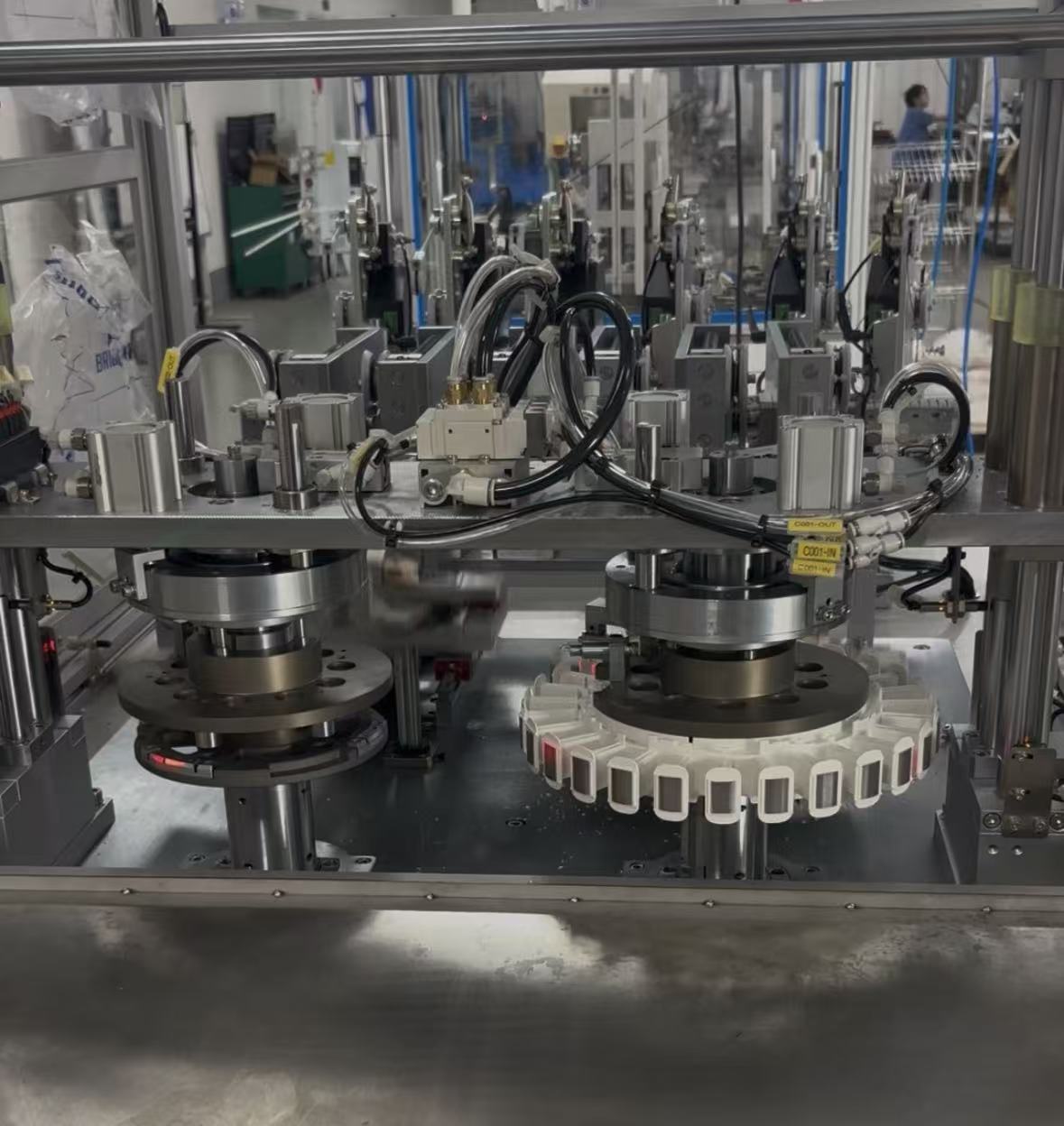
A washing machine motor production line for DD designs typically combines:
1. Stator manufacturing — high-speed stamping of core strip, curling and sizing of the large-diameter core, and precision needle winding with multi-station winders. 2. Rotor manufacturing — rotor core pressing, magnet insertion machines with automated gluing or clipping, and magnetizing with verification. 3. Final assembly — rotor-stator pairing with controlled air gap, hall sensor or encoder fitting, housing and connector assembly, and end-of-line testing for noise, vibration, and electrical performance. 4. Traceability — each motor carries its winding, magnetization, and test data for quality tracking.
Because DD motors run at low speed with direct coupling, end-of-line noise and vibration testing is more demanding than for belt-drive motors. Lines are increasingly specified with acoustic test chambers and automated balancing.
What this trend means for motor factories
For appliance motor plants, the message is straightforward: direct drive is becoming the default architecture in the segments that matter most. Factories planning capacity for the next five years should evaluate whether their lines can handle large-diameter outer-rotor designs, automated magnet insertion, and noise-grade testing — the three capabilities that define DD motor manufacturing.
Frequently asked questions
Q: What is a DD motor in a washing machine? A: A DD (direct drive) motor couples directly to the drum without a belt or gearbox. It is usually a large-diameter outer-rotor BLDC motor, valued for quiet operation, reliability, and efficiency.
Q: Are DD motors better than belt-driven motors? A: For noise, reliability, and control precision, yes — which is why they dominate premium machines and are moving into mid-range models. Belt drives remain common in entry-level machines because of lower cost.
Q: What equipment is needed to manufacture DD washing machine motors? A: Large-diameter lamination stamping, precision needle winding machines, rotor magnet insertion machines, magnetizing equipment, controlled-gap assembly stations, and end-of-line noise and vibration testing.
Q: Is direct drive only for washing machines? A: No. The same outer-rotor direct drive architecture appears in other appliances and industrial applications where quiet, direct torque matters.
Planning or upgrading a washing machine motor production line? We design turnkey motor assembly lines for DD direct drive motors — from stator winding and magnet insertion to final assembly and end-of-line testing. Tell us your target model and capacity, and we will propose a line configuration.
Product page: https://www.ldmotortech.com/en/products/motor-assembly Related capability: motor core stamping automation at https://www.ldmotortech.com/en/products/stamping